
True luxury isn't found in the curated silence of a high-end showroom; it's earned through the slow, deliberate synthesis of architectural intent and the raw, tactile soul of the artisan. You've likely felt the hollow disappointment of generic luxury items that lack a true pulse, pieces that feel detached from the spaces they inhabit and the histories they should honor. It's frustrating to seek a home that reflects your unique narrative only to be met with silhouettes that prioritize surface-level aesthetics over structural soul. We believe that bespoke furniture should be more than a decorative afterthought. It's a fundamental extension of interior architecture, a structural dialogue between the past and the future that ensures every piece possesses both intellectual weight and uncompromising integrity.
In this exploration, you'll discover how the rigorous precision of architectural theory merges with ancestral craftsmanship to create timeless legacy pieces. We'll examine the technical depth required to bridge traditional South Asian heritage with the restrained elegance of modern minimalism. You'll learn how the careful selection of materials and the mastery of techniques like brass inlay transform a simple object into a vessel for cultural storytelling. This journey will provide you with the confidence to curate a space where furniture and architecture exist in a state of perfect, history-preserving harmony.
Key Takeaways
- Distinguish the intellectual depth of bespoke furniture from simple customization by understanding the collaborative dialogue between the architect, the artisan, and the client.
- Learn how the selection of premium hardwoods and stone respects the technical architecture of a space while ensuring absolute structural longevity.
- Discover the artistic value in blending ancestral South Asian joinery and brass inlay with the refined minimalism of modern Middle Eastern design.
- Recognize the vital role of rigorous technical drawings and blueprinting in bridging the gap between a soulful conceptual vision and a perfectly executed installation.
- Gain insight into how intentional, high-quality commissions serve as sustainable legacy pieces that evolve into cherished family antiques over generations.
Defining the Philosophy of Bespoke Furniture
To understand the essence of a truly curated home, one must first dismantle the modern conflation of "custom" and "bespoke". While the former often implies the mere adjustment of pre-existing templates or the selection of finishes from a predetermined catalog, the definition of bespoke is rooted in a far more profound commitment to original creation. It's a radical departure from the assembly line. Bespoke furniture represents a blank canvas where the specific requirements of a client, the intellectual rigour of an architect, and the tactile wisdom of an artisan converge into a single, cohesive form. This isn't just about choosing a fabric; it's about a tripartite dialogue that ensures every structural choice is a direct response to the spatial narrative it inhabits. In this context, the artisan isn't merely a manufacturer but a co-author of a story that spans generations.
Beyond Customization: The Act of Creation
Furniture acts as a silent language. It speaks to the identity of a room, articulating values that mass-market items simply cannot express. When you move from consumerism toward curation, you aren't just buying an object; you're commissioning a marriage of form and function that refuses to acknowledge the transience of trends. Every curve and joint in a bespoke piece serves an intentional narrative purpose. This intentionality creates a lifecycle that extends far beyond the seasonal churn of the retail world. It's about history-preserving design that views the present through a lens of future legacy. By rejecting the "off-the-shelf" mentality, the client gains a piece that possesses a soul, one that resonates with their personal journey while respecting the technical constraints of the physical environment.
The Architect as a Furniture Designer
At Yoca Interiors, our philosophy is inseparable from the architectural heritage of the Najmi Bilgrami Collaborative. We don't view a chair or a table as a standalone accessory but as a piece of micro-architecture. This mindset of the Philosophical Creator requires a synthesis of spatial planning and object design. If the architecture defines the volume of a room, the furniture defines its soul. By applying the same technical drawings and structural discipline used in large-scale buildings to the creation of a single cabinet, we ensure that the piece isn't just beautiful but structurally honest. It's a process of relearning-and-reinventing ancient techniques to fit a modern, minimalist framework. This architectural approach to bespoke furniture ensures that the technical architecture of the room and the furniture within it are in constant, harmonious conversation.
The Architectural Integrity of Bespoke Manufacturing
The integrity of a commissioned object lies in its structural honesty. Unlike retail pieces that rely on superficial veneers and hidden fasteners, bespoke furniture requires the same intellectual rigour as a building's blueprint. Every joint and load-bearing element is drafted with the precision of a technical drawing. This ensures the piece doesn't just sit in a room but actively complements its technical architecture. We treat the creation of a dining table or a credenza as a micro-architectural project. This level of detail is necessary to avoid the structural failures often seen in generic luxury items, ensuring that the furniture functions as a permanent fixture rather than a transient accessory.
Material Synthesis: Wood, Metal, and Stone
Selection of material is an act of curation that considers the entire lifecycle of the object. We prioritize premium hardwoods, stone, and brass, choosing grains that mirror the architectural flow of a space, such as the expansive vistas of a Dubai penthouse. These are "honest" materials. They age gracefully, developing a patina that tells a story rather than deteriorating into waste. The Investment Value of Bespoke Design lies in this material longevity. By using brass inlay as a bridge-building element between traditional South Asian motifs and contemporary minimalism, we create a visual language that is both grounded and forward-looking. This "collaging" of multiple textures within a single piece reflects a shift toward more soulful, personalized environments.
Joinery and the Soul of the Object
The soul of a piece is often hidden within its joinery. Traditional techniques, such as mortise and tenon or dovetail joints, eliminate the need for modern adhesives that eventually fail under stress. This creates "living" pieces. They breathe and move with the environment, adapting to changes in humidity and temperature without losing their structural integrity. This requires a level of technical accuracy that mass-production simply cannot replicate. Our team of over 100 architects and artisans works in a state of continuous-movement-and-evolution to ensure every piece is a masterclass in structural integration. If you are seeking to harmonize your furniture with your home's layout, exploring the possibilities of interior architecture can provide the necessary foundation for a truly unified space.
Marrying Traditional Craftsmanship with Contemporary Form
Cities like Dubai represent a triumph of global minimalism, yet the human spirit often craves the warmth of a cultural anchor within these expansive glass-and-steel volumes. This is where the juxtaposition of South Asian heritage and modern Middle Eastern aesthetics becomes a vital design strategy. We don't view tradition as a static relic of the past; instead, we see it as a living language that must be translated for the contemporary world. By integrating ancestral motifs and manual techniques into bespoke furniture, we provide a soulful counterpoint to the sometimes sterile nature of modernism. This synthesis allows a home to feel both internationally sophisticated and deeply rooted in a specific cultural lineage, ensuring that the interior tells a story that transcends the current design season.
The Art of the Re-learned Craft
At Yoca Interiors, we treat the design process as a profound act of re-learning, where ancient wisdom is extracted from its historical isolation and re-contextualized for the modern world. This isn't simple production; it's a transformation-focused-and-artisan-led journey that seeks to merge the technical with the organic. Consider the delicate balance required when blending heritage brass work with minimalist marble surfaces. The cold, precise nature of the stone provides a canvas for the warm, hand-wrought texture of the metal, creating a rhythmic tension that defines high-end design. The Yoca Collection serves as a definitive case study in this cultural synthesis, showcasing how disparate elements can coexist through the disciplined application of architectural theory and manual mastery.
Heritage in the Modern UAE Home
In the evolving landscapes of Abu Dhabi and Riyadh, the demand for a unique marriage of heritage and modern aesthetics has never been more pronounced. As homes move toward vast, contemporary open-plan layouts, bespoke furniture acts as a series of anchors that define specific zones while preserving a sense of identity. These pieces function as micro-architectural landmarks within the home. They offer a sense of permanence in a world of globalized, transient trends. By choosing commissions that respect traditional joinery and local materiality, homeowners can achieve several key outcomes:
- The preservation of cultural identity within a rapidly modernizing urban environment.
- A seamless integration between the structural minimalism of the room and the tactile richness of the objects within it.
- The creation of a living space that feels curated and intentional rather than merely decorated.
This approach ensures that every object is more than just a utility; it's a vessel for history, reinvented for the way we live today. It's about building a legacy that feels as relevant in a high-rise penthouse as it does in a traditional courtyard home.
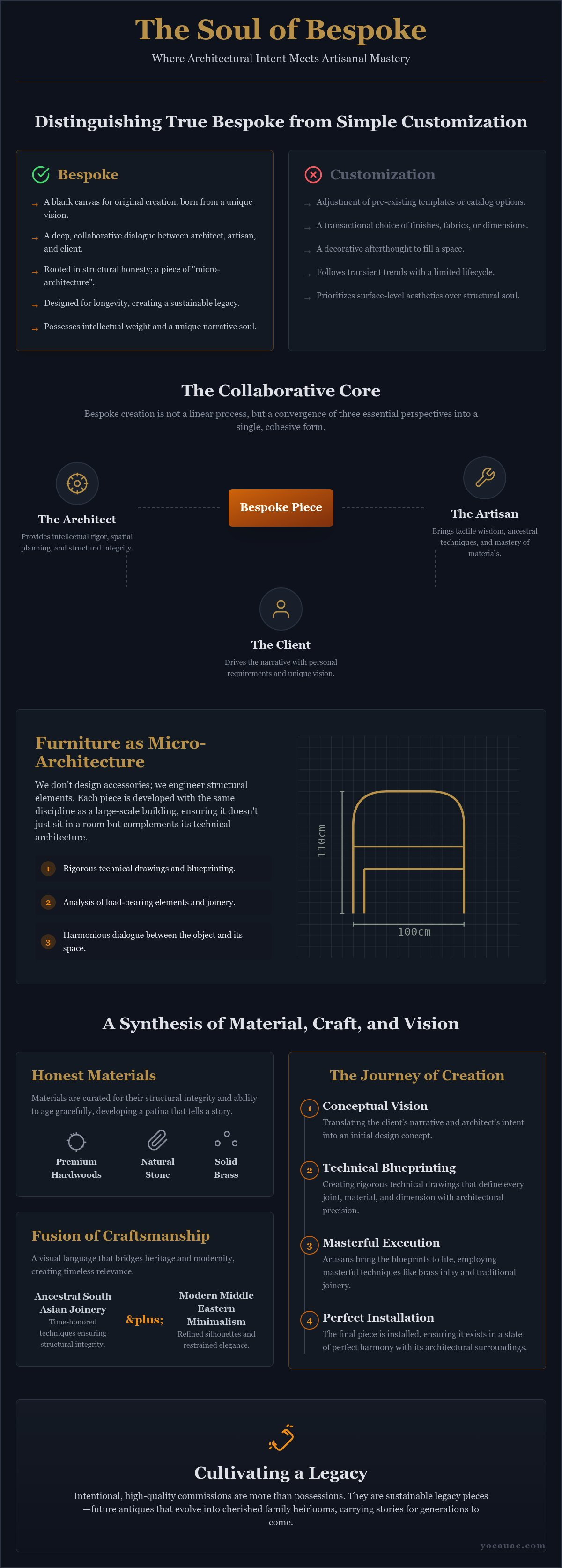
The Journey of Creation: From Vision to Installation
The evolution of a singular object from a conceptual spark into a permanent architectural fixture is a methodical, narrative-driven process that rejects the haste of modern production. It begins with a deep-immersion-and-collaborative-dialogue, typically within the creative atmosphere of the Dubai Design District, where the architect and client work to unearth the underlying "why" of a piece. This stage is less about dimensions and more about the spatial narrative the object is intended to complete. By translating personal histories or cultural values into initial sketches and complex 3D models, we ensure the bespoke furniture is a direct manifestation of the client's identity rather than a detached aesthetic choice. Every vision requires the discipline of technical architecture. Before a single piece of wood is cut, the design undergoes a rigorous blueprinting phase, resulting in technical drawings that match the complexity of a building's structural plans. This approach ensures that the eventual form is not just a visual success but a structural one, capable of seamless integration into the home's existing layout.
Conceptualizing the Spatial Narrative
The conceptual phase is where the synthesis of the intellectual and the personal occurs. It's a time for exploring how a specific curve or a particular choice of brass inlay might mirror the broader architectural themes of a residence. By prioritizing the philosophical underpinning of the design, we move beyond the superficial customization found in standard showrooms. This dialogue allows us to anticipate how a piece will interact with light, movement, and the surrounding volumes, ensuring that the final installation feels like an inevitable part of the room's history. It's an act of curated storytelling where the furniture becomes the language of the space.
The Artisan’s Workshop
Once the blueprints are finalized, the journey transitions into the tactile, soulful environment of the workshop. Here, a collective of over one hundred architects and artisans engages in a rhythmic-and-methodical workflow to bring the technical drawings to life. The process is characterized by a reinvention of ancient manual techniques, where hand-finishing a table or a console becomes an act of artistic devotion. This phase is not merely about manufacturing; it's about preserving the integrity of the human touch within a high-precision framework. The process concludes with rigorous on-site project supervision. Our team ensures that every structural modification and installation detail is executed with absolute fidelity to the original vision. This final oversight guarantees that the piece fits the space with architectural exactitude. To begin your own collaborative journey, we invite you to commission your own bespoke furniture with our team of visionaries.
Cultivating a Legacy: The Investment Value of Bespoke Design
In a world defined by the rapid acceleration of consumer cycles, the choice to commission bespoke furniture is an act of quiet rebellion. It's a move away from the transient and toward the permanent. When an object is conceived with architectural rigour and crafted with artisanal soul, it ceases to be a mere commodity; it becomes a future antique. These pieces carry the weight of a family legacy, intended to be passed down through generations as vessels of personal and cultural history. Beyond the emotional resonance, there is a clear economic logic to this level of curation. In the competitive luxury real estate markets of Dubai and Abu Dhabi, homes featuring integrated, high-quality commissions often command higher resale values because they offer a level of spatial maturity that mass-market retail cannot replicate. You aren't just furnishing a room; you're investing in a structural asset that matures over time.
The Sustainability of Timelessness
True sustainability is found in the "lifecycle of creation" rather than the efficiency of the supply chain. By choosing materials that endure the unique, demanding climate of the Middle East, such as solid hardwoods and hand-wrought brass, we avoid the environmental cost of the mass-market churn. This approach respects the ethical value of supporting traditional artisanal communities, ensuring that ancient skills are preserved through modern demand. It's a philosophy that values the slow, the deliberate, and the enduring. When a piece is built to last for a century, its carbon footprint is amortized over a lifetime of use; this makes it a far more responsible choice than the "disposable luxury" found in many global showrooms. Investing in quality is, at its heart, an environmental commitment.
Curating Your Personal Sanctuary
Living in a space designed with absolute intentionality has a profound emotional impact. It transforms a house from a collection of rooms into a curated sanctuary that reflects your intellectual and artistic journey. The Yoca Interiors philosophy is centered on this transformation, moving the needle from simple decoration to a deep-seated sense of belonging. As you begin your journey of curation, consider starting with a singular anchor piece; a console or a dining table that embodies your aesthetic values can serve as the foundation for an entire room. From there, the transition from interior styling to comprehensive interior architecture becomes a natural progression. This holistic approach ensures that every element of your home, from the walls to the smallest brass inlay, exists in a state of perfect, history-preserving harmony.
Designing for Generations to Come
The journey toward a truly curated home requires a shift from consuming transient trends to commissioning permanent legacy. We've explored how bespoke furniture serves as a vital bridge between the intellectual rigour of architectural theory and the ancestral wisdom of manual craftsmanship. By treating every object as a piece of micro-architecture, we ensure that your living space isn't just decorated but structurally and culturally unified. Our award-winning architectural heritage informs every technical drawing, while our team of over 100 master artisans brings those visions to life with absolute fidelity. This commitment to on-site project supervision and material honesty ensures that your furniture remains a permanent, history-preserving fixture. It's time to move beyond the generic and embrace a spatial narrative that is uniquely yours. We invite you to Explore the Yoca Collection and Commission Your Legacy Piece to begin the transformation of your residence into a soulful sanctuary. Your home's story is waiting to be written through the language of intentional design.
Frequently Asked Questions
What is the difference between custom-made and bespoke furniture?
Bespoke furniture begins with an original concept rather than a pre-existing template. While custom-made pieces often involve adjusting the dimensions or finishes of a catalog item, a bespoke commission is a dialogue-driven act of pure creation. It's a structural response to a specific architectural volume. This ensures the final object possesses a unique soul and technical integrity that retail modifications simply can't achieve.
How long does it typically take to manufacture a bespoke furniture piece in the UAE?
Lead times for a singular commission typically range from eight to twelve weeks, though this varies based on the complexity of the technical drawings and material sourcing. The artisanal nature of manual joinery and hand-finishing requires a methodical pace that cannot be rushed. We prioritize structural honesty over speed. This ensures every piece arrives with the durability required to become a future antique within your home.
Why should I choose an interior architecture firm for my furniture design?
An interior architecture firm views furniture as micro-architecture rather than a standalone accessory. This ensures a seamless synthesis between the volume of the room and the form of the object. By utilizing rigorous blueprinting and on-site project supervision, architects ensure that the piece complements the home's structural modifications. It's a holistic approach that guarantees technical accuracy and aesthetic harmony across the entire living environment.
Can bespoke furniture be integrated into an existing modern interior?
One-of-a-kind commissions act as soulful anchors within the restrained volumes of a minimalist interior. A piece of bespoke furniture provides a tactile counterpoint to the clean lines of a modern penthouse, introducing a sense of history and human touch. This juxtaposition creates a rhythmic tension that elevates the space. It moves the room away from a sterile showroom feel toward a deeply personal, curated sanctuary.
What materials are best suited for bespoke furniture in the Middle East climate?
Premium hardwoods, natural stone, and brass are exceptionally suited to the unique environmental demands of the Middle East. These "honest" materials possess a structural density that resists the warping often seen in mass-market alternatives. We focus on traditional joinery that allows the wood to breathe and move naturally. This ensures the piece ages gracefully, developing a rich patina rather than deteriorating under fluctuating humidity levels.
How does the commissioning process work for a one-of-a-kind piece?
The process begins with a collaborative dialogue to define the spatial narrative, followed by the creation of detailed technical drawings. Once the blueprint is finalized, our collective of over 100 artisans begins the manual manufacturing phase in our workshop. Every step is overseen by architects to maintain design integrity. The journey concludes with professional installation, ensuring the piece fits its intended environment with absolute architectural precision.
Is bespoke furniture a good investment for high-end properties in Dubai?
Investing in bespoke furniture significantly enhances the long-term value of high-end properties in Dubai. These pieces are recognized as structural assets that elevate the maturity of an interior. Unlike retail furniture that depreciates rapidly, a commissioned legacy piece retains its worth as a future antique. It distinguishes a property in a competitive market by offering a level of cultural depth and material quality that is increasingly rare.
How do you balance traditional craftsmanship with a minimalist aesthetic?
We achieve balance by re-learning ancient techniques, such as brass inlay, and applying them to the restrained silhouettes of modern minimalism. This synthesis allows the technical precision of the architect to meet the organic soul of the artisan. The result is a piece that feels internationally sophisticated yet deeply rooted in cultural heritage. It's a dialogue between eras that ensures the furniture remains timelessly relevant in a globalized world.


